Address
Room 2301C, 23rd Floor, Building 1, jinghu Commercial center, No, 34, Liangzhuang Street, Eri District, Zhengzhou City, Henan province
Woours
Monday to Friday: 7AM - 7PM
Weekend: 10AM - 5PM
Address
Room 2301C, 23rd Floor, Building 1, jinghu Commercial center, No, 34, Liangzhuang Street, Eri District, Zhengzhou City, Henan province
Woours
Monday to Friday: 7AM - 7PM
Weekend: 10AM - 5PM


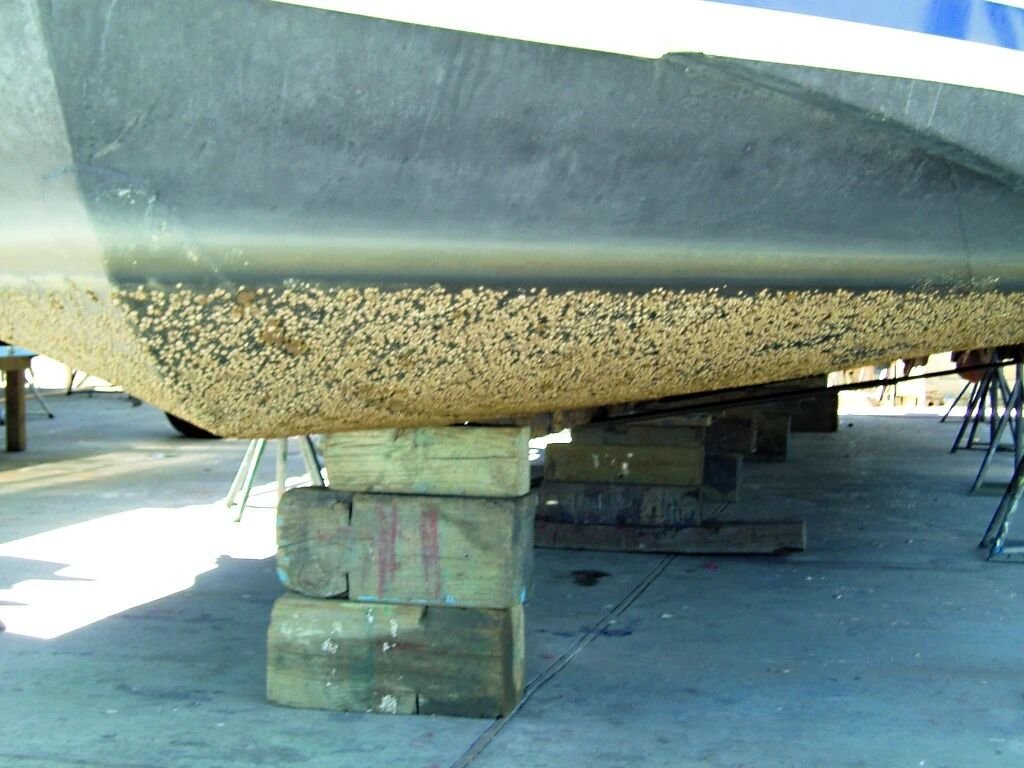
Marine vessels must overcome immense resistance during navigation, and fouling by marine organisms further increases this resistance, increasing energy consumption while also posing a threat to navigation safety and ship lifespan.
Using antifouling and drag-reducing coatings is currently one of the most cost-effective methods for reducing ship fouling. With the increasing emphasis on green development of the marine economy, traditional antifouling coatings containing copper and tin are being phased out, replaced by newer, more environmentally friendly, cost-effective, and efficient antifouling and drag-reducing coatings.

1.Low surface energy antifouling and drag reducing coatings
Research has shown that foul-release coatings, with their superhydrophobic and flexible surface properties, can help prevent fouling and reduce drag on ships. Also known as low-surface-energy antifouling coatings, foul-release coatings prevent fouling organisms from attaching through physical rather than chemical action.
Due to the coating’s low surface free energy and elastic modulus, fouling organisms cannot firmly adhere to the coating surface and are easily dissociated by the shear forces of water flow. Importantly, this process does not require the release of antifouling agents and does not kill the fouling organisms.
Foul-release coatings also offer advantages such as a high solids content and smooth surface, which help reduce water resistance. Given their greener potential compared to traditional coatings such as Wuxi self-polishing antifouling coatings, researchers are conducting extensive research on foul-release coatings, aiming to develop them into a major market alternative to traditional biocidal coatings.
Currently, research on low-surface-energy coatings primarily focuses on silicone and organofluorine materials.
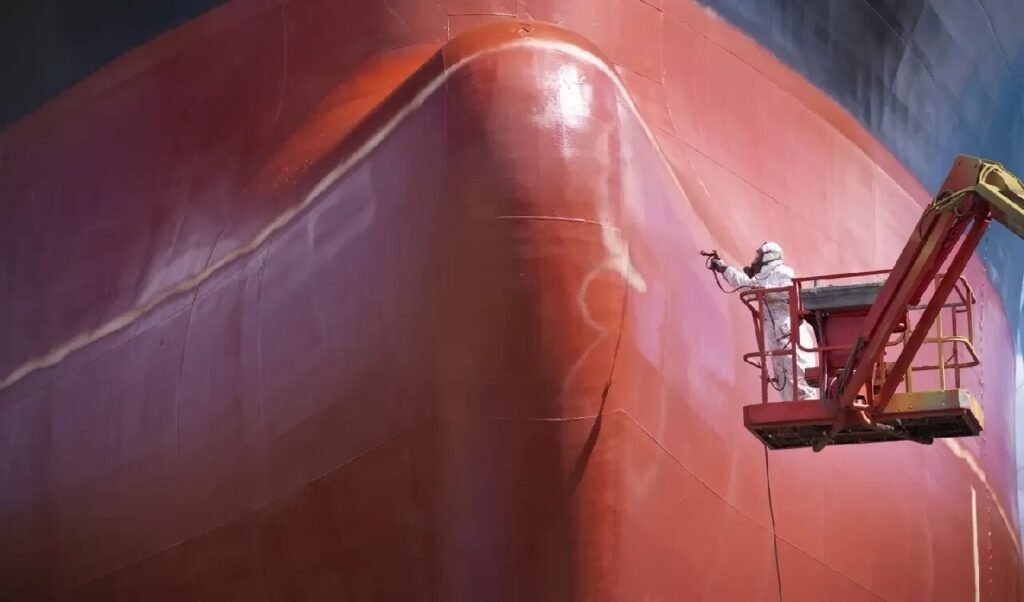
1).Silicone low surface energy coating
Silicones offer a competitive price and excellent physicochemical properties, making silicone-based coatings the most widely used in low-surface-energy coating research.
Silicone elastomers, particularly polydimethylsiloxane (PDMS), are the most commonly used polymers in fouling-release coatings. The backbone of PDMS is composed of alternating silicon and oxygen atoms. The Si-O chain structure provides excellent flexibility, while the methyl groups in the side chains are highly nonpolar. This repulsion of polar water molecules results in a strong hydrophobicity, resulting in low surface energy, low elastic modulus, and low surface roughness, endowing the coating with excellent desorption properties.
However, the flexible backbone of PDMS and the weak interactions between its molecular chains result in poor mechanical strength and adhesion. PDMS antifouling coatings are poor at removing mucus composed of bacteria and diatoms. Under static conditions, these mucus tends to adhere to hydrophobic surfaces and is not easily released through hydrodynamic shearing.
This adherent mucus creates hydrodynamic drag on a moving ship, also increasing fuel costs. In order to effectively improve the adhesion, mechanical properties and antifouling ability of coatings under static conditions, polymer modification, bionic composite modification and other methods have become the current research focus of silicone antifouling coatings.
Silicone foul-release coatings are prone to peeling from substrates (typically epoxy primers). To enhance the bond strength between silicone foul-release coatings and substrates, researchers have explored methods such as introducing polar interactions, adding intermediate tie layers, and using coupling agents (such as bis(γ-trimethoxysilylpropyl)amine and γ-glycidoxypropylmethyldiethoxysilane) to adjust the interfacial mechanical properties.
However, these methods still suffer from high costs, complex processes, and poor adhesion and mechanical properties. Consequently, researchers are often exploring strategies such as incorporating nanofillers and modifying with polyurethanes and epoxy resins to improve the adhesion and mechanical properties of silicone foul-release coatings.
2). Organic fluorine low surface energy coating
Fluorine atoms have the highest electronegativity and form tight, stable C−F bonds within organic compounds. Therefore, fluorinated monomers have relatively short carbon chains, and fluorinated polymers are highly hydrophobic and chemically inert. The preparation of resins based on fluorinated polymers has become a major research focus in low-surface-energy coatings.
Fluorinated segments in amphiphilic systems are being used to enhance the fouling-release properties of coatings due to their low surface energy properties. Several surface-active block copolymers with fluoroalkyl side chains, amphiphilic semifluorinated block copolymers, and amphiphilic perfluoropolyether/polyethylene glycol networks have been explored and used in the development of antifouling coatings.These coatings offer both resistance to settling and enhanced release of marine microorganisms.
Compared to silicone low-surface-energy antifouling coatings, the main challenges in developing fluoropolymer low-surface-energy coatings are the high curing temperature, high cost, and insufficient adhesion of fluororesins.
Polytetrafluoroethylene, a widely studied material, also faces challenges such as insufficient resin density, the concentration of fouling organisms in micropores, and complex processing, hindering its widespread adoption in antifouling and drag reduction applications.
Given the advantages and disadvantages of silicone and organofluorine materials, researchers are increasingly considering introducing fluorinated groups or fluorinated polymers into the silicone matrix to achieve even better antifouling performance. This approach maintains the high elasticity of the macromolecule while further reducing surface energy through the introduction of fluorinated groups. A rational combination of silicone and organofluorine coatings can further leverage the advantages of low-surface-energy materials.
2.Bionic antifouling and drag-reducing coatings
Biomimetic antifouling strategies, inspired by the natural surfaces of plants and animals, are considered a promising and environmentally friendly approach to marine antifouling.
Research on biomimetic antifouling coatings falls into two main categories: extracting substances with antifouling activity from organisms, and creating specialized surface-structured materials that mimic the surface structures of plants and animals.
1). Natural antifouling agent biomimetic coating
Traditional antifouling coatings have negative environmental impacts and difficult-to-control release rates, necessitating the development of new, environmentally friendly, and durable antifouling agents.
Given that many organisms have acquired antifouling capabilities during evolution, researchers have explored natural antifouling agents and their derivatives from various organisms. These agents have shown promise in combating biofouling, and the number of newly developed natural antifouling agents is increasing annually. The chemical composition and structure of these natural antifouling agents offer promising avenues for the development of novel marine bio-antifouling and medical antifouling coatings.
Capsaicin and its derivatives are natural plant alkaloids with unique physicochemical properties and are widely recognized as one of the most promising antifouling agents. Cross-linking copolymers of capsaicin derivatives with hydrogels to create antifouling coatings significantly enhances both antifouling and antibacterial properties.
Curcumin, a natural polyphenolic compound extracted from turmeric, exhibits potent antimicrobial activity against both Gram-negative and Gram-positive bacteria by interfering with mitotic proteins. The resulting antifouling coating exhibits both antimicrobial activity and hydrophilicity, as well as excellent resistance to protein and platelet adsorption.
Natural antifouling agents (including organic acids, terpenes, phenols, and indoles) are currently considered effective alternatives to traditional antifouling agents. However, challenges such as complex extraction processes, low extraction rates, high costs, and poor durability require further resolution.

2). Bionic structural coatings
Aquatic organisms in nature have their own unique antifouling methods in still or slow-moving water. When it comes to designing antifouling physical structures, few artificial solutions can surpass the ingenious structures that have evolved over thousands of years in aquatic organisms.
Compared to chemical methods, physical methods are considered more environmentally friendly because they do not release toxic substances into the marine system. Inspired by natural structures found in marine organisms like shark skin, sea urchin spicules, and mussel shells, researchers have made some progress in developing biomimetic micro- and nanostructured antifouling coatings.
However, technical complexity, inefficiency, and high costs remain. In harsh environments, the micro- and nanostructures on a material’s surface can be damaged, reducing performance and shortening its lifespan. Therefore, the development of biomimetic structural surfaces with stable mechanical properties is a pressing research direction.
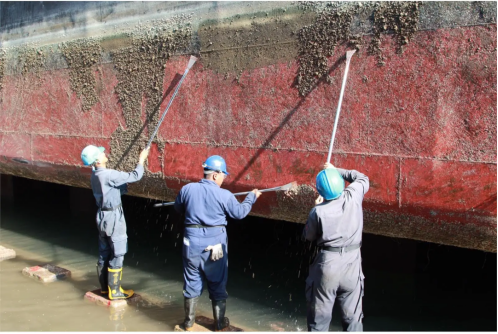
With the advancement of green development in the marine economy, the demand for upgraded, environmentally friendly coatings for ships will significantly increase in the future. In the antifouling and drag-reducing coatings sector, significant research progress has been made both domestically and internationally in the areas of silicone, organofluorine, natural antifouling agents, and biomimetic structural coatings.
At the same time, addressing certain issues surrounding antifouling and drag-reducing coatings requires further research on the balance between antifouling and mechanical properties, deeper understanding of the underlying mechanisms of surface performance, and continuous improvement. Furthermore, efforts are needed to continuously enhance the synthesis process, efficiency, broad-spectrum properties, durability, ease of application, and environmental friendliness of finished coatings. Furthermore, a unified and effective accelerated evaluation method should be developed to promote the diversified development of coating applications.