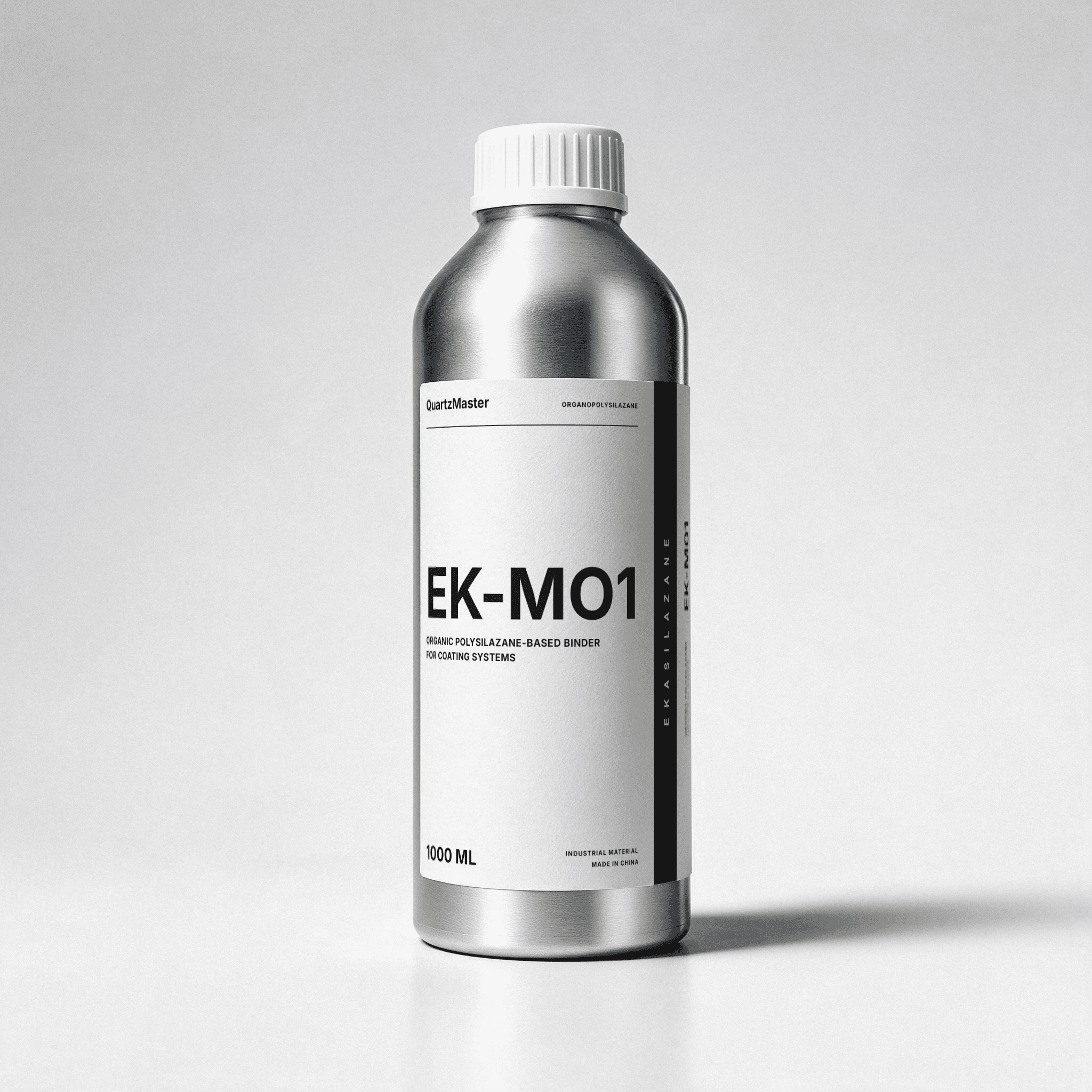
EK-M01
Epoxy-modified silazane coating
Paint and coating protection; room-temperature application, short-term up to 500 °C.
FORM
One-component coating
APPEARANCE
Translucent to pale-white liquid
CURING
Ambient / 150 °C · >24 / <0.5 h
Documents
TDS · SDS
Potting / encapsulation at 250–500 °C (Adhesives)
The material
How this grade works and where it fits — exact parameters are defined in the TDS.
This product uses polysilazane as the principal film-forming binder, combined with epoxy resin, together with small amounts of auxiliaries such as a diluent, a polymerization retarder and a leveling agent. It is designed to solve the problems of room-temperature application and ambient-temperature curing that are difficult to achieve with conventional ceramic coatings.
The film has high pencil hardness and resists yellowing. It is suitable for protective coatings over painted finishes; insulating, voltage-withstand, abrasion-resistant and aging-resistant coatings; as an auxiliary agent for carbon fiber, glass fiber and similar materials; and for high-temperature bonding, road, bridge and construction bonding, weather-resistant anticorrosive coatings, insulating heat-resistant electrical components and mechanical protective coatings. In outdoor use it is hydrophobic and easy to clean; after curing it forms covalent bonds with the substrate, and this chemical bonding greatly increases the mechanical strength of the adhesive layer.
Choose this grade as the epoxy-modified all-rounder: room-temperature or 150 °C cure, ≥6H, -30…300 °C service — the default where general adhesion and corrosion protection are needed.
Final fit is confirmed during technical review — send your substrate, operating environment and application process, and the team will confirm this grade or point you to a closer one.
Suitable for
Industrial applications within the TDS parameters
Metal, glass, ceramic and stone substrates — per grade
Professional application and curing processes
Not intended for
Consumer or DIY use — industrial B2B supply only
Conditions outside the parameters defined in the TDS
Food-contact or medical use unless explicitly confirmed
Applications
Recommended application areas for this grade, based on its TDS. Application fit is confirmed during technical review.
Recommended applications for this grade:
Technical data
Key values from this grade's TDS. The complete measured data set follows below; the official document is available on request.
PROPERTY
TYPICAL VALUE
NOTES
Solid content
>60% coating · >65% resin ((120±2) °C)
—
Viscosity
TBC in TDS
—
Max service temperature
-30 to 300 °C service · 500 °C peak
Depends on cure & film build
Curing conditions
Ambient / 150 °C · >24 / <0.5 h
Per application process
Recommended film thickness
8–120 µm
—
Shelf life
12 months (storage at 5–30 °C)
Storage conditions apply
Service temperature. Suitable for outdoor service conditions at temperatures below 300 °C and for short-term high-temperature service at 500 °C. The temperature resistance of the adhesive layer varies according to the temperature resistance of the particular substrate; the product withstands hot-cold cycling and thermal shock (note: the corresponding product differs for different substrates).
Coating Film Properties
Color and appearance: Translucent to pale-white liquid — GB/T 1721-79
Solids content ((120±2) °C): >65% — GB/T 1725-2007
Density (g/mL): 0.9 ± 0.02 — GB/T 6750-2007
Hardness (pencil): ≥6H — GB/T 6739-2006
Adhesion: Grade 0 — GB/T 9286-1998
Neutral salt spray resistance: >500 h — GB/T 1771-2007
Water contact angle: ≥105° — GB/T 26490-2011
Artificial weathering resistance: 3 d: no rusting, no chalking, no cracking, slight discoloration — GB/T 1865-2009
Dielectric strength (V/mm): ≥10⁵ — ASTM D149
Resistance (Ω·m): ≥10¹³ — GB/T 35856-2018
Basic Application Parameters
Solids content (%): >60
Volatility: Solvent evaporates readily
Theoretical coverage (m²/kg): 6–8
Curing temperature (°C): Ambient / 150
Dry film thickness (µm): 8–120
Curing time (h): >24 / <0.5
Working time (pot life) (h): 4
Maximum instantaneous temperature resistance (°C): 500
Thinner: Aromatic hydrocarbons, esters, ethers, etc.
Recommended service temperature (°C): -30 to 300
Flash point (°C): <22 (solvent flash point)
Storage (°C): 0–30
Data above is taken from the manufacturer’s TDS. Request the official document via the documents section below.
Substrates & storage
Compatibility and handling essentials — confirmed per grade in the TDS and SDS.
Suitable substrates
Steel and stainless steel
Aluminium and other metals
Glass and ceramics
Stone and mineral surfaces
Bonding of carbon steel, stainless steel, cast iron, aluminum alloys, titanium alloys, high-temperature alloy steels, glass-ceramic panels, ceramics, cement, leather and stone. Note: the adhesive formulation differs depending on the substrate; within a certain range it can be adjusted to match the substrate and its service conditions.
Storage, packaging & transport
Store in accordance with national regulations. The storage environment must be dry, cool and well ventilated, away from heat and ignition sources. Packaging containers must be kept tightly sealed and placed with care.
Storage temperature must be maintained between 5 °C and 30 °C; shelf life is 12 months.
Unused adhesive must be promptly resealed tightly in its container and used as soon as possible.
Dispensed adhesive that is not used up cannot be reclaimed; dispose of it in accordance with local regulations.
Product past its shelf life may be used only after testing confirms it still meets specification.
Packaging
1 kg / 5 kg / 25 kg (grade-dependent)
Transport classification
Per SDS
Application process
General guidance — exact parameters are provided in the TDS and Application Guide.
01
Surface preparation
Clean, degrease and prepare the substrate.
02
Application
Spray, dip or wipe depending on grade.
03
Curing
Cure per the TDS conditions.
04
Quality control
Verify film build and adhesion.
Standard process: Surface cleaning → abrasive roughening → cleaning and blow-off → EK-M01 application → curing
Abrasive roughening. Before coating, sand or blast the substrate surface to remove rust, dust, dirt and other contamination adhering to the workpiece. Surface roughening has a major influence on adhesive-layer performance — Sa2.5 is optimal, St3 with no mill scale is the minimum (GB/T 30790.4-2014) — so pay close attention to this step.
Cleaning. Use a dedicated cleaner or degreaser to remove oil, dust and other residues remaining on the roughened surface.
Substrate drying. Before coating, ensure the substrate surface is dry and clean.
Adhesive filtration. This product is one-component; dispense the required amount and filter through a 120-mesh screen before use.
Adhesive application and bonding. Apply the adhesive to the surfaces of the workpiece to be bonded and fix them in place. After surface curing the adhesive layer is somewhat hydrophobic and oleophobic, so repeated recoating is not recommended.
Curing. After application, room-temperature curing: surface-dry takes more than 1 hour, touch-dry more than 12 hours, and dry-through more than 72 hours. Rapid curing by heating is also possible (hold at 150 °C for 60 minutes).
Note: This is a one-component curing product; once the container is opened, use it within 4 hours. During longer breaks in application, clean the application tools thoroughly to prevent them from setting up. Application in a single spray pass is recommended, with a dry film thickness not exceeding 150 µm; otherwise film performance will decline.
More grades
Browse the full catalogue by category, or send your requirements — we will recommend a grade for your case.
Organic Polysilazane Resins
→
Inorganic Polysilazane / Ceramic Precursors
→
Modified Polysilazane Coatings
→
Ready-to-use Ceramic Coatings
→
High-temperature Ceramic Coatings
→
Electrical Insulation Coatings
→
Fluorosilanes & Surface Modifiers
→
Adhesives
→
Additives
→
Polycarbosilane
→
Cyclosilazanes
→
Silazane Monomers
→
SiC Fibers
→
Ordering & logistics
Common questions from procurement and engineering teams.
What packaging formats are available?
Standard packaging is 1 kg, 5 kg and 25 kg containers, grade-dependent. Other formats, minimum order quantity, lead times, shipping terms and stock availability are confirmed on request.
What is the minimum order quantity for this product?
MOQ depends on the packaging format — confirmed by our team for your grade and volume.
What happens after I send an inquiry?
Our technical team reviews your requirement and responds with a recommendation, the relevant documents and next steps.
How do I get a quotation?
Include your estimated volume and application in the inquiry — a quotation follows the technical review.
How is the product shipped?
Packaging, transport classification and shipping details are provided per SDS — request packaging and shipping information with your inquiry.