Organic Polysilazane Resins
Base polysilazane resins and liquid ceramic precursors — binders, clear varnishes and synthesis feedstock for SiCN, SiCNO and SiO2 systems. Full data per grade in the TDS, provided on request.
The grades
Grades in this family. Specifications are confirmed in the product TDS.

EK-1300
→
High-temperature curing polysilazane resin
Solvent-free heat-cured polysilazane binder and resin modifier; 5–7H, reactive with epoxy, isocyanate, amine and phenolic groups.

EK-1800
→
UV-curing polysilazane resin
Solvent-free UV-curing polysilazane; 80–85% ceramic yield, withstands 1000 °C peaks after ceramisation.

EK-S01
→
Room-temperature curing transparent silazane varnish
Transparent RT-curing varnish for electronics, easy-clean and outdoor anti-corrosion.

EK-S02.1500 RC
→
Room-temperature fast-curing polysilazane resin
Solvent-free liquid polysilazane, fast ambient moisture cure; 6–8H, water contact angle 100–110°.

EK-S02.1500 SC
→
Room-temperature slow-curing polysilazane resin
Solvent-free liquid polysilazane, slow ambient moisture cure; 6–7H, water contact angle 100–110°.

EK-S03
→
High-temperature curing agent (methylhydrogen polysilazane)
Methylhydrogen polysilazane (MW >8×10⁴) — high-temperature curing agent and crosslinker.

EK-S04
→
Methylvinylsilazane
Low-molecular silazane — amine curing agent and modifier for epoxy, alkyd, acrylic resins.

EK-S05
→
High-molecular polysilazane binder
Binder for steel coating systems; precursor for SiCN, SiCNO and SiO2 ceramics.

EK-S06
→
Polyborosilazane resin
Film-former for self-cleaning anti-corrosive coatings; air cure below 200 °C, >6H.

EK-S08
→
Solid polysilazane resin, high-temperature curing
Solid resin for ceramic-precursor routes, flame-retardant systems and HT adhesives.
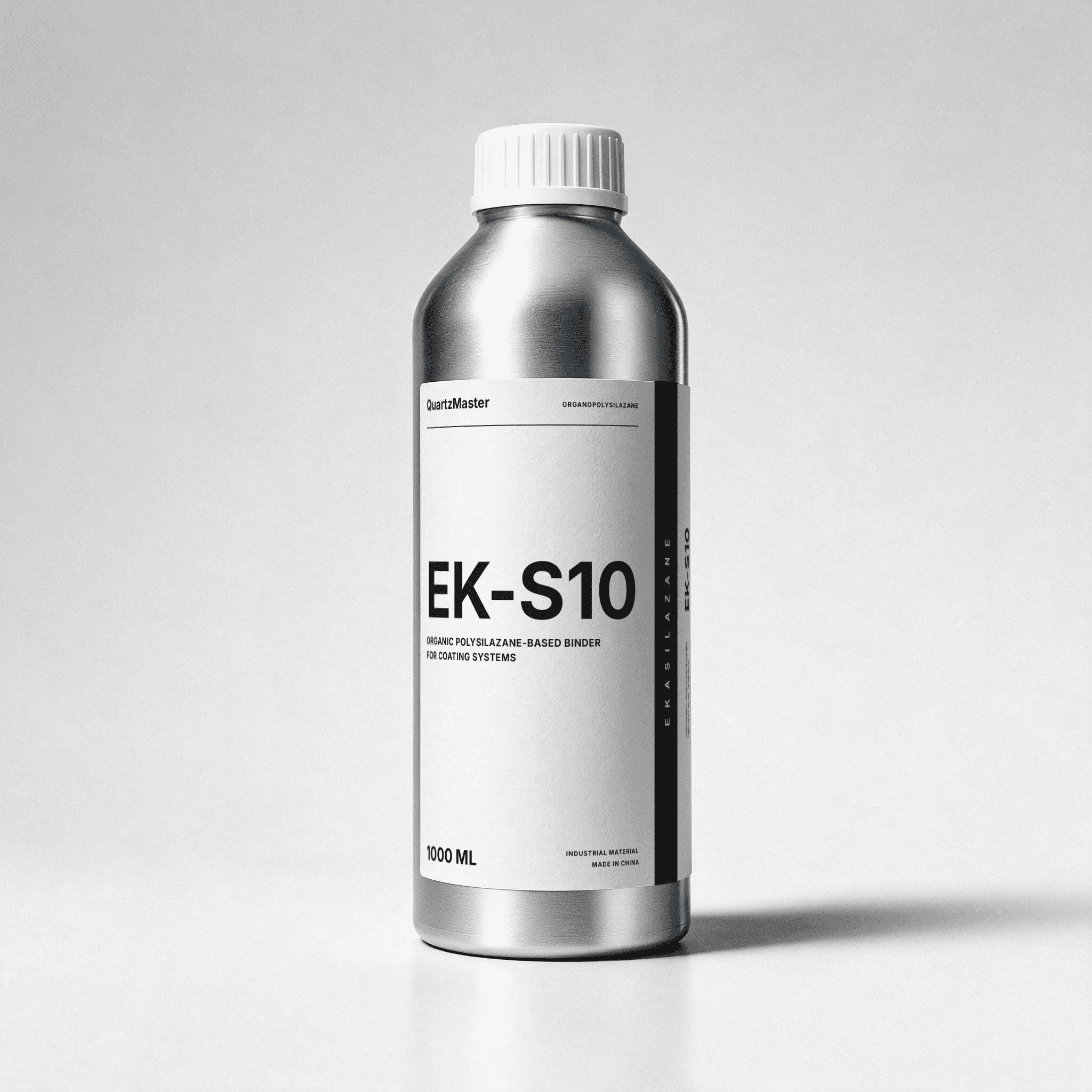
EK-S10
→
Polyaluminosilazane resin
Polyaluminosilazane resin; >75% ceramic yield, also for ceramic-precursor routes.

EK-S11
→
Low-molecular methylhydrogen polysilazane
Low-molecular polysilazane (MW 177–591) for composites, impregnation and thin films.

EK-S1303
→
Solvent-based polysilazane, full cure in one day
Solvent-based low-viscosity polysilazane with the fastest full cure in the range — one day — and contact angle 105–110°.
Compare grades
How the grades in this family differ. Exact values are confirmed in each product TDS.
EK-1300
Solvent-free liquid resin
<500 °C in air
150–200 °C · 4–8 h
Heat-cure binder; reacts with epoxy and amine
EK-1800
Solvent-free liquid resin
<500 °C · 1000 °C peak
200–250 °C · 1–4 h
UV-curing binder, 80–85% ceramic yield
EK-S01
Liquid varnish
−30 to 500 °C · 800 °C peak
Ambient or 180 °C
Standard clear protective coat, ≥7H
EK-S02.1500 RC
Solvent-free liquid resin
<500 °C in air
Ambient · full cure 3–7 days
Fast-curing binder — full cure 3–7 days
EK-S02.1500 SC
Solvent-free liquid resin
<500 °C in air
Ambient · full cure 5–10 days
Slow-curing binder — longer open time
EK-S03
Liquid resin
−30 to 300 °C · 600 °C peak
180–250 °C · 1 h
High-temperature curing agent, MW >8×10⁴
EK-S04
Liquid resin
−30 to 400 °C · 800 °C peak
250 °C · 1.5 h
C=C reactive; addition-cure routes
EK-S05
Liquid precursor
−30 to 700 °C · 1000 °C peak
250 °C · 1 h
SiCN/SiO₂ ceramics, fibres, composites
EK-S06
Coating base
≤200 °C air · >850 °C in nitrogen
Air: ambient or 85 °C · N₂: >600 °C
Polyborosilazane self-cleaning anticorrosion
EK-S08
Solid granules
−30 to 800 °C
260 °C · 1 h
Powder routes; ceramic-yield work
EK-S10
Solid resin
−30 to 1000 °C · 1300 °C peak
250 °C · 1 h
Polyaluminosilazane, SiAlCN ceramics, ≥8H
EK-S11
Liquid resin
−30 to 400 °C · 800 °C peak
180–250 °C · 1 h
Low-MW grade — composites and impregnation
EK-S1303
Solvent-based liquid resin
500 °C in air
Ambient · full cure 1 day
Fastest full cure in the range — one day
* From each grade’s TDS. Final selection is confirmed during technical review.
Key properties
Typical properties of this family — exact values depend on product grade and are confirmed in the TDS.
Ceramic conversion
Converts to SiCN, SiCNO or SiO2 ceramics on curing.
Reactive chemistry
Si–H, Si–N and vinyl sites for crosslinking and modification.
Form flexibility
Liquids and solids across a viscosity and molecular-weight range.
High-temperature resistance
Service up to 700–1000 °C depending on grade.
Hardness
Cured films reach 3H–8H depending on grade.
Binder performance
Adhesion to metals, glass and ceramics.
Applications
Industrial challenges where this material family is typically evaluated.

Anti-corrosion Coatings
→
Protect metal and concrete against moisture, salt and chemical exposure.

Hydrophobic & Oleophobic Treatment
→
Water and oil repellency and anti-fingerprint treatment.

Automotive Coatings
→
Industrial automotive applications and component protection.

Industrial Metal Protection
→
Corrosion, chemical and thermal protection for metal parts.
Documents
Request the documents you need, or start a guided evaluation — everything is provided per product grade.
FAQ
Common questions about this material family.
How do the grades in this family differ?
The grades differ in temperature range and application profile — exact values are in each product TDS. Send your operating conditions and we will recommend a grade.
Can I test the material before committing to volume?
Yes — sample support is available for qualified B2B projects after a short technical review.
Which substrates are compatible?
Steel, stainless and other metals are typical. Compatibility for a specific substrate is confirmed per grade in the TDS.
How is this different from conventional high-temperature paint?
Silazane-derived coatings convert to a dense ceramic layer, designed for service beyond the range of conventional organic paints. Comparative data is available on request.
What is the minimum order quantity?
MOQ depends on the product and packaging format — to be confirmed with our team for your grade.
Send request
From first enquiry to qualified bulk supply — send your requirements below.
01
Send requirement
Application, substrate and performance target.
02
Get recommendation
Suitable material family and product grade.
03
Receive TDS/SDS, catalog & sample
Documentation and sample for evaluation.
04
Test material
Validate on your substrate and process.
05
Confirm & bulk supply
Specification agreement and ongoing supply.
About organic polysilazane resins
These resins are supplied as liquids or solids and are used both directly — as binders, varnishes and impregnation media — and as precursors that convert to SiCN, SiCNO and SiO2 ceramics on curing. Grade choice follows the target chemistry, viscosity and cure route.
Typical evaluation starts with the substrate, operating temperature and application process. Exact temperature limits, film thickness and curing parameters depend on the product grade and are confirmed in the TDS. Sample support is available for qualified B2B projects.