Inorganic Polysilazane / Ceramic Precursors
Perhydropolysilazane (PHPS) — inorganic ceramic precursors forming pure SiO2 and glass-ceramic layers. Grades and specifications are being confirmed with the manufacturer.

The grades
Grades in this family. Specifications are confirmed in the product TDS.

EK-1800
→
UV-curing polysilazane resin
Solvent-free UV-curing polysilazane; 80–85% ceramic yield, withstands 1000 °C peaks after ceramisation.

EK-S03
→
High-temperature curing agent (methylhydrogen polysilazane)
Methylhydrogen polysilazane (MW >8×10⁴) — high-temperature curing agent and crosslinker.

EK-S05
→
High-molecular polysilazane binder
Binder for steel coating systems; precursor for SiCN, SiCNO and SiO2 ceramics.

EK-S06
→
Polyborosilazane resin
Film-former for self-cleaning anti-corrosive coatings; air cure below 200 °C, >6H.

EK-S08
→
Solid polysilazane resin, high-temperature curing
Solid resin for ceramic-precursor routes, flame-retardant systems and HT adhesives.

EK-S08-X
→
Thermoplastic solid polysilazane for fibres and prepregs
Solid thermoplastic polysilazane with a controllable 40–120 °C softening point; precursor for silicon nitride fibre and prepreg matrices.
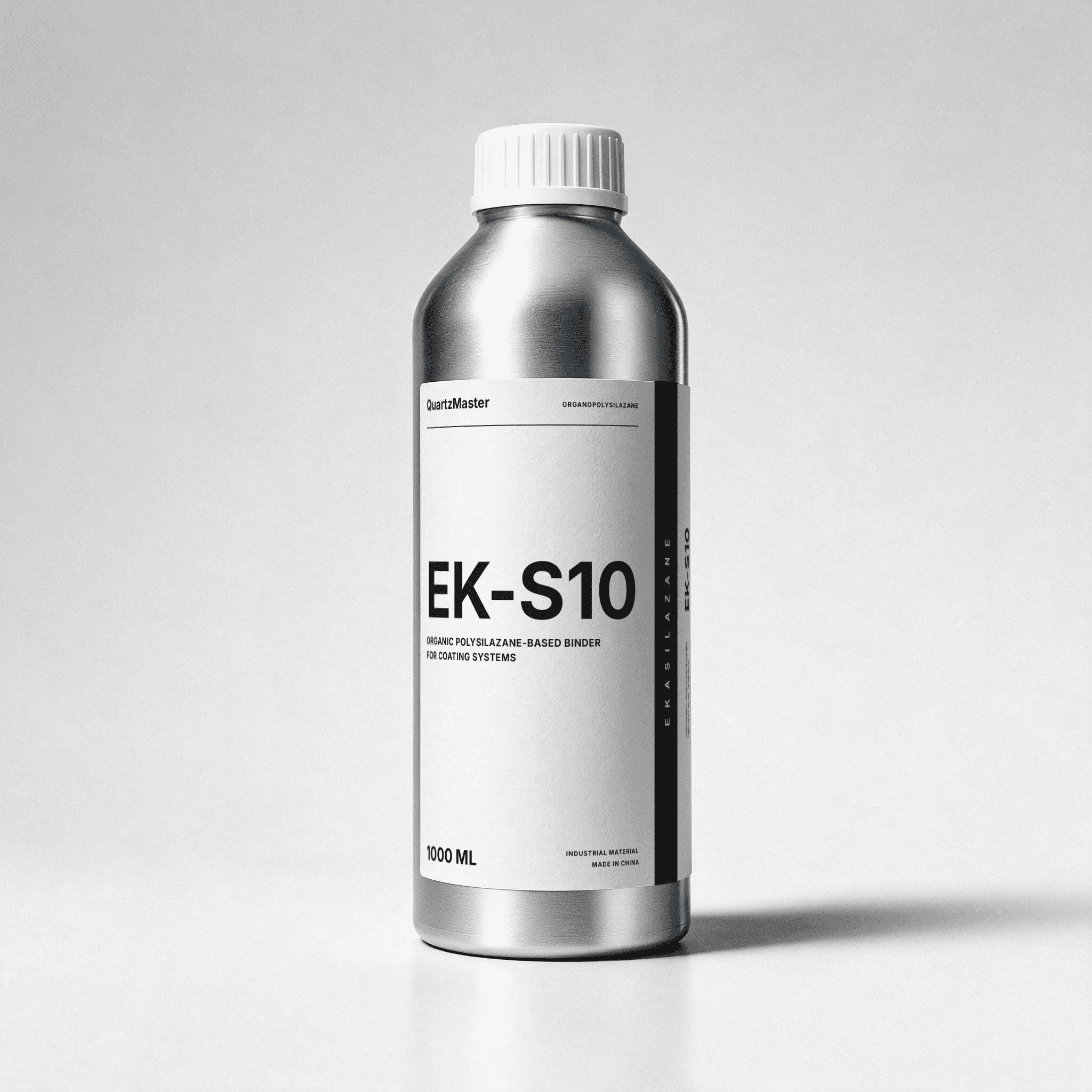
EK-S10
→
Polyaluminosilazane resin
Polyaluminosilazane resin; >75% ceramic yield, also for ceramic-precursor routes.

PHPS
→
Perhydropolysilazane
Inorganic polysilazane precursor forming pure SiO2 / glass-ceramic layers.
Compare grades
How the grades in this family differ. Exact values are confirmed in each product TDS.
EK-1800
Solvent-free liquid resin
<500 °C · 1000 °C peak
200–250 °C · 1–4 h
UV-curing binder, 80–85% ceramic yield
EK-S03
Liquid resin
−30 to 300 °C · 600 °C peak
180–250 °C · 1 h
High-temperature curing agent, MW >8×10⁴
EK-S05
Liquid precursor
−30 to 700 °C · 1000 °C peak
250 °C · 1 h
SiCN/SiO₂ ceramics, fibres, composites
EK-S06
Coating base
≤200 °C air · >850 °C in nitrogen
Air: ambient or 85 °C · N₂: >600 °C
Polyborosilazane self-cleaning anticorrosion
EK-S08
Solid granules
−30 to 800 °C
260 °C · 1 h
Powder routes; ceramic-yield work
EK-S08-X
Solid thermoplastic resin
1000 °C peak after ceramisation
250 °C · 2–4 h
Fibre spinning and prepreg matrices
EK-S10
Solid resin
−30 to 1000 °C · 1300 °C peak
250 °C · 1 h
Polyaluminosilazane, SiAlCN ceramics, ≥8H
PHPS
Per TDS
Per TDS
Per TDS
Inorganic precursor, SiO₂ and Si₃N₄
* Values are confirmed in the product TDS — request the TDS library for exact data.
Key properties
Typical properties of this family — exact values depend on product grade and are confirmed in the TDS.
Pure SiO2 layers
Converts to glass-like silica on curing.
Thin films
Dense, transparent sealing layers.
Electronics duty
Dielectric and barrier applications.
Optical clarity
Transparent coatings for optics and glass.
Low-temperature conversion
Moisture-assisted cure routes.
Grades TBC
Specifications being confirmed with the manufacturer.
Applications
Industrial challenges where this material family is typically evaluated.

High-temperature Protection
→
Thermal and oxidation protection for demanding environments.

Electrical Insulation
→
Dielectric protection for electronics, energy and components.

Electronics & Energy
→
Protective and insulating layers for components and systems.

Solar / Photovoltaic
→
Protection for PV glass, frames and components.
Documents
Request the documents you need, or start a guided evaluation — everything is provided per product grade.
FAQ
Common questions about this material family.
How do the grades in this family differ?
The grades differ in temperature range and application profile — exact values are in each product TDS. Send your operating conditions and we will recommend a grade.
Can I test the material before committing to volume?
Yes — sample support is available for qualified B2B projects after a short technical review.
Which substrates are compatible?
Steel, stainless and other metals are typical. Compatibility for a specific substrate is confirmed per grade in the TDS.
How is this different from conventional high-temperature paint?
Silazane-derived coatings convert to a dense ceramic layer, designed for service beyond the range of conventional organic paints. Comparative data is available on request.
What is the minimum order quantity?
MOQ depends on the product and packaging format — to be confirmed with our team for your grade.
Send request
From first enquiry to qualified bulk supply — send your requirements below.
01
Send requirement
Application, substrate and performance target.
02
Get recommendation
Suitable material family and product grade.
03
Receive TDS/SDS, catalog & sample
Documentation and sample for evaluation.
04
Test material
Validate on your substrate and process.
05
Confirm & bulk supply
Specification agreement and ongoing supply.
About inorganic polysilazane / ceramic precursors
Perhydropolysilazane converts to pure SiO2 on curing — thin glass-like layers for electronics, optics and surface sealing. Grades and processing data are being confirmed with the manufacturer.
Typical evaluation starts with the substrate, operating temperature and application process. Exact temperature limits, film thickness and curing parameters depend on the product grade and are confirmed in the TDS. Sample support is available for qualified B2B projects.