High-temperature Protection
Protect metal parts against heat, oxidation and thermal cycling with polysilazane-based coating systems. We don’t promise a universal result — we recommend a specific material for your substrate and operating temperature, confirmed by documentation and a sample.

Recommended products
Proposed starting points — the final recommendation for your case follows technical review.

EK-1800
→
UV-curing polysilazane resin
Solvent-free UV-curing polysilazane; 80–85% ceramic yield, withstands 1000 °C peaks after ceramisation.

EK-M21
→
High-temperature boron-nitride oil-based mold release agent
BN-modified release agent for high-temperature molds; ambient to 1500 °C.

EK-S03
→
High-temperature curing agent (methylhydrogen polysilazane)
Methylhydrogen polysilazane (MW >8×10⁴) — high-temperature curing agent and crosslinker.

EK-S04
→
Methylvinylsilazane
Low-molecular silazane — amine curing agent and modifier for epoxy, alkyd, acrylic resins.

EK-S05
→
High-molecular polysilazane binder
Binder for steel coating systems; precursor for SiCN, SiCNO and SiO2 ceramics.

EK-S08
→
Solid polysilazane resin, high-temperature curing
Solid resin for ceramic-precursor routes, flame-retardant systems and HT adhesives.

EK-S08-X
→
Thermoplastic solid polysilazane for fibres and prepregs
Solid thermoplastic polysilazane with a controllable 40–120 °C softening point; precursor for silicon nitride fibre and prepreg matrices.
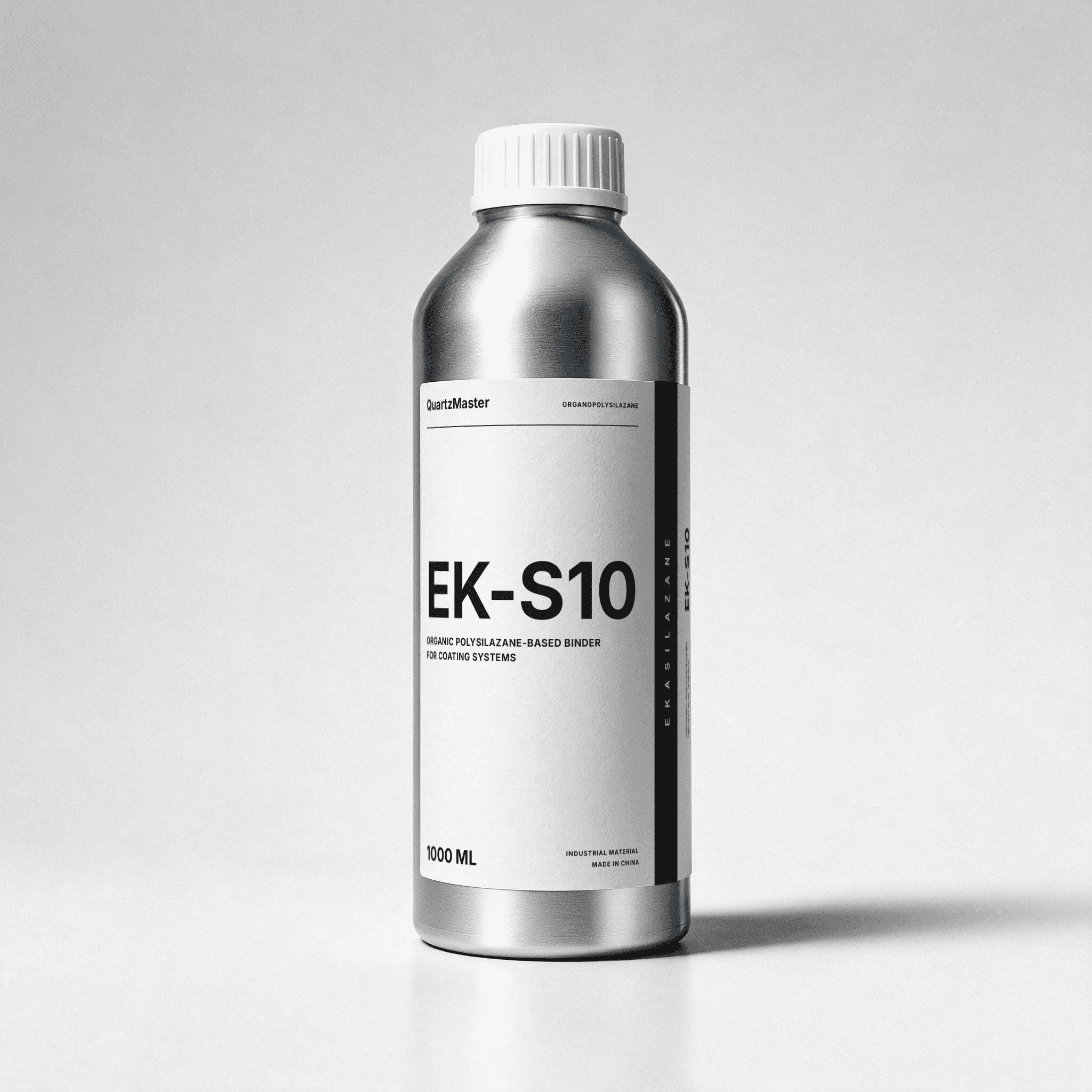
EK-S10
→
Polyaluminosilazane resin
Polyaluminosilazane resin; >75% ceramic yield, also for ceramic-precursor routes.

EK-S1000
→
High-viscosity polysilazane for thick-film industrial coatings
High-viscosity heat-curing polysilazane for films 0.1–0.4 mm thick; 1000 °C peak service after ceramisation.

EK-S11
→
Low-molecular methylhydrogen polysilazane
Low-molecular polysilazane (MW 177–591) for composites, impregnation and thin films.

EK-S1303
→
Solvent-based polysilazane, full cure in one day
Solvent-based low-viscosity polysilazane with the fastest full cure in the range — one day — and contact angle 105–110°.

EK-S1502
→
Solvent-based ultra-fast-curing polysilazane resin
Solvent-based low-viscosity polysilazane; tack-free in 20–30 minutes, 7–8H hardness, water contact angle 98–104°.

EK-S8001
→
Hexamethylcyclotrisilazane, CAS 1009-93-4
Cyclic silazane monomer for ring-opening polymerisation to high-molecular-weight polysilazanes; cyclics ≥95%.

EK-SiBCN
→
Boron-modified polysilazane for wave-transparent and 1700 °C coatings
Boron-modified polysilazane rated to 1700 °C with wave-transparent properties and high-temperature self-healing; two viscosity grades.

Polycarbosilane
→
Polycarbosilane (PCS)
Preceramic precursor for silicon carbide ceramics and SiC fibers.

SiC Fibers
→
Continuous silicon carbide fibers
Continuous SiC fiber for high-temperature composite reinforcement.
The challenge
Recognise your situation — and what it costs when heat protection fails.
Heat, oxidation and thermal cycling attack metal surfaces continuously in high-temperature service. When a protective layer fails, the cost is not just recoating — it is downtime, part replacement and safety risk.
Conventional organic paints have limits at elevated temperatures. Silazane-based systems form a dense protective layer designed for longer service in hot, oxidising conditions — the right grade and film build are confirmed during technical review.
Typical situations
Exhaust and combustion systems — sustained heat and hot gases
Furnaces, kilns and burners — high-temperature process heat
Outdoor and industrial equipment exposed to thermal load
Heat exchangers, ducting and process equipment
How the protection works
Ceramic protection layer
Dense barrier against heat, oxidation and thermal cycling
Polysilazane layer
Adhesion, curing and surface conversion
Substrate
Steel, stainless, alloy or mineral surface
Requirements
Properties that matter for high-temperature protection — availability depends on product grade and is confirmed in the TDS.
Heat & oxidation resistance
Dense layer limiting oxidation and heat damage.
Chemical stability
Holds up under sustained heat and cycling — per grade.
Adhesion at temperature
Reliable bonding to prepared substrates under heat.
Thermal cycling resistance
Keeps the barrier intact through repeated heating.
Chemical stability
Where hot gases and residues are part of the environment.
Long-term durability
Designed for extended service — validated on your parts.
Substrates & industries
Where these systems are typically applied. Compatibility is confirmed per grade — not guaranteed generically.
Typical substrates
Carbon and stainless steel
Aluminium and heat-resistant alloys
Cast iron and mineral substrates
Prepared / primed surfaces per guide
Typical industries
Exhaust, foundry and heat-treatment equipment
Furnace and thermal process industry
Energy and power generation
Metal fabrication and heavy equipment
FAQ
Common questions about high-temperature coating projects.
Can the coating be applied to an already oxidised surface?
Surface preparation requirements — including scale and oxide removal — are defined in the Application Guide. The condition of your surface is assessed during technical review.
How is this different from conventional heat-resistant paint?
Silazane-based systems form a dense ceramic-like layer designed for high-temperature environments. Comparative data for a specific grade is available on request.
How much heat can the protection handle?
Performance depends on the grade, film build and application quality — we validate it on your parts through sample testing rather than promising generic numbers.
Which product should I start with?
Send your substrate, operating temperature and process — our team will recommend a grade and provide the TDS. Custom formulation is possible subject to technical review.
Can I test before committing to volume?
Yes — sample support is available for qualified B2B projects after a short technical review.
What about MOQ and pricing?
Both depend on the grade, packaging and volume — include your estimated quantity in the request and a quotation follows the technical review.
Send request
From first enquiry to qualified bulk supply — send your requirements below.
01
Send requirement
Application, substrate and performance target.
02
Get recommendation
Suitable material family and product grade.
03
Receive TDS/SDS, catalog & sample
Documentation and sample for evaluation.
04
Test material
Validate on your substrate and process.
05
Confirm & bulk supply
Specification agreement and ongoing supply.
About high-temperature protection
High-temperature coatings protect metal assets against heat, oxidation and thermal cycling in industrial environments. Polysilazane-based systems form a dense protective layer for hot service conditions.
Product selection depends on the substrate, operating temperature and application process. Technical data sheets, application guides and sample support are provided on request for each product grade.